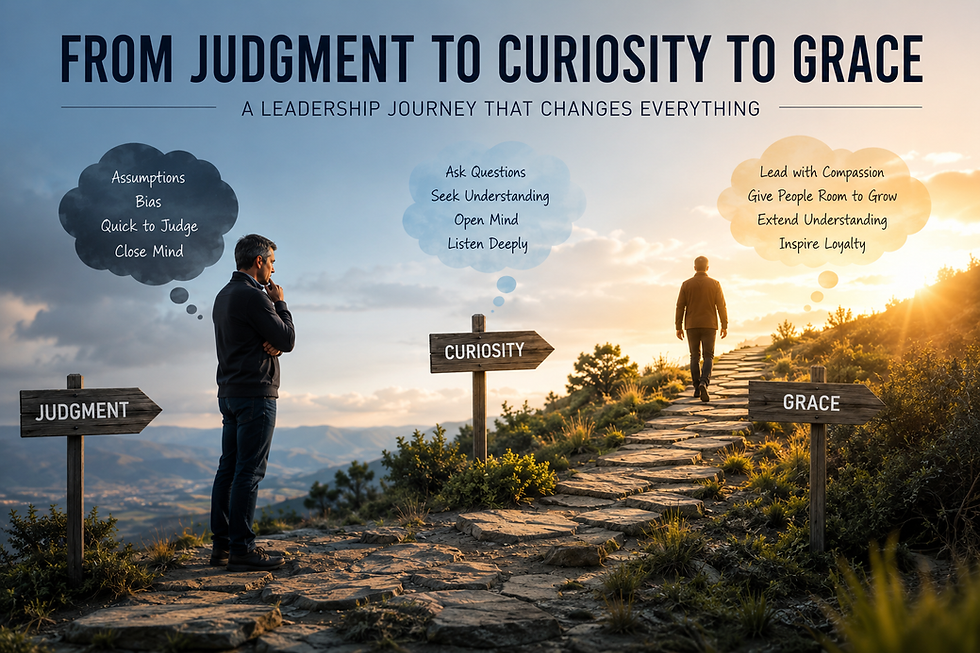
From Judgment to Curiosity to Grace: The Leadership Journey That Changes Everything: Why today's leaders must replace assumptions with understanding—and understanding with compassion
It happened in less than thirty seconds. A manager watched an employee walk into work ten minutes late for the third time that week. Before the employee even reached their desk, the manager had already written the story in their head.
"They're disengaged."
"They don't care."
"This generation has no work ethic."
What the manager didn't know was that the employee had become the primary caregiver for a father recently diagnosed with dementia. Every morning began with helping him get dressed, preparing breakfast, and waiting for a home health aide who had been arriving unpredictably.
Same behavior. Completely different story. Leadership often isn't about having better answers. It's about asking better questions.
We Are Wired to Judge
Our brains are remarkable pattern-recognition machines. Within seconds, we categorize, predict, and decide. That ability helped our ancestors survive. But in today's workplace, it often gets us into trouble.
When an employee misses a deadline...
When a customer lashes out...
When a colleague disagrees with us...
Our first instinct is often to explain their behavior before we truly understand it. Judgment is fast. Understanding takes effort. Unfortunately, speed isn't always wisdom.
The First Leap: From Judgment to Curiosity
Curiosity changes the conversation. Instead of asking, "What's wrong with this person?"
We begin asking:
"What might I not know?"
"What's influencing this behavior?"
"Help me understand what you're experiencing."
Curiosity doesn't excuse poor performance or inappropriate behavior. It simply delays conclusions long enough for truth to emerge. I've worked with organizations around the world, and I've noticed something remarkable. The highest-performing leaders aren't necessarily the smartest people in the room. They're the most curious. They recognize that every employee brings experiences, pressures, fears, and aspirations that aren't immediately visible.
The same is true for customers. Every complaint has a backstory. Every difficult conversation has unseen context. Curiosity uncovers what judgment overlooks.
The Second Leap: From Curiosity to Grace
Curiosity helps us understand.
Grace determines how we respond.
This is where leadership becomes transformational. Grace doesn't mean lowering expectations. It doesn't mean ignoring accountability. Grace means choosing compassion before condemnation. It means believing people are more than their worst moment.
It means recognizing that everyone—including ourselves—is carrying something invisible.
Grace says:
"I understand what happened. Now let's figure out how we move forward together."
That's a very different conversation from:
"You disappointed me again."
One creates defensiveness.
The other creates commitment.
Why This Matters for Customer Experience
Organizations spend millions trying to improve customer experience. Yet many overlook one simple truth: Employees cannot consistently extend grace to customers if they rarely experience it themselves. Think about the organizations you admire.
Their employees stay calm when customers become frustrated and they assume positive intent. They look for solutions instead of someone to blame and that behavior doesn't happen by accident. It reflects the culture created by leadership. When leaders lead with curiosity, employees feel safe. When employees feel safe, they become more engaged. When employees are engaged, customers notice.
Employee engagement and customer experience are inseparable.
Three Questions Every Leader Should Ask
Before reacting to someone's behavior, pause and ask yourself:
1. What story am I telling myself?
Is it based on facts—or assumptions?
2. What might I be missing?
What circumstances, pressures, or perspectives haven't I considered?
3. What response would demonstrate both accountability and humanity?
Leadership isn't choosing between high standards and compassion.
The best leaders insist on both.
Grace Isn't Soft. It's Strategic.
Some leaders worry that grace makes them appear weak. I've found the opposite. People willingly follow leaders who make them feel seen. They trust leaders who listen before they decide. They stay with organizations where mistakes become learning opportunities rather than permanent labels.
In today's workplace, where change is constant and uncertainty is high, technical skills alone won't inspire people. Human skills will. Judgment may feel efficient but, curiosity creates understanding.
Grace creates loyalty.
And loyalty—among employees and customers alike—is one of the few competitive advantages that technology can never automate. As Maya Angelou famously said, "People will forget what you said, people will forget what you did, but people will never forget how you made them feel."
Leadership is no different.
Every interaction leaves an emotional footprint. The question isn't whether you're influencing your people. It's whether you're leading them with judgment—or with curiosity and grace. Because extraordinary leaders don't just change performance.
They change people.
Let's Continue the Conversation
How has curiosity changed a difficult conversation you've had as a leader?
Share your thoughts in the comments—I read every one, and your experience may be exactly what another leader needs to hear.


Comments